(CEEDR) - L3
Administrative referent
04 66 65 70 85
Pedagogical referent
04 66 65 65 79
Registration
Montpellier Faculty of Education
Training location
Florac
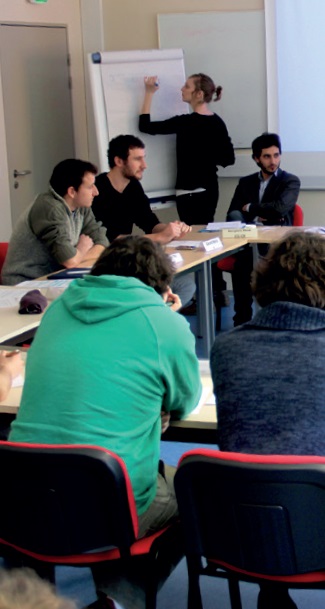
This bachelor's degree provides training for careers in the development and implementation of educational projects (for the general public, throughout life) on environmental and sustainable development issues. It can be taken as an initial training course or on a sandwich course.
 The particularities of alternating work-study programs :
- 18 weeks of classes, 34 weeks on the job
- 5 to 6 periods of 1 to 4 weeks at the Florac Institute
With contributions from :
- School and Nature Network
- local authorities
- Graine Occitanie
- CPIE
- Université du Québec à Montréal
- CPIE Lozère - Réel 48 ... and many others
Skills :
- Educational responsibility and intervention in EEDD training: Trained in educational science and pedagogy, in the field of the environment, graduates will also acquire in-depth knowledge of the players and issues specific to sustainable development, as well as the skills needed to manage teams and lead projects.
- Network coordination: Facilitate the circulation of information, set up participative practices, initiate projects and federate players and partners, organize events.
- Consulting and mediation: Identify local issues and stakeholder logics, and implement consultation and negotiation processes. Help communities and educational establishments move towards sustainable development.
Job opportunities
The structures recruiting are :
- Companies specializing in supporting local authorities or training and educational establishments in the field of education for sustainable development.
- Associations involved in environmental education and sustainable development at departmental, regional and even national level.
- Local authorities, regional nature parks...
- Other potential employers include companies and organizations in the social economy (SCOP, etc.) that are developing strong sustainable development and awareness-raising initiatives. This sector is growing.
Training is organized over an academic year, starting in September, in Florac, Lozère. It includes :
- two weeks of immersion at the Florac institute and one week of observation in a company or association (on the employer's premises for alternating students)
- courses and tutorials: 400 hours. Part of the teaching will be based on an active, project-based approach.
- tutored project: 130 hours
- work experience: 14 weeks from April to June / in a company as part of a work-study or continuing education program
- assessment: continuous assessment or final assessment at the end of each module. Oral defense of compulsory report
- a "Professional and personal project" module prepares students for their professional integration
Holders of a Bac+2 diploma (DUT, BTSA, DEUST, L2) in the fields of environment, geography, biology, educational sciences, social intervention.
Continuing education: jobseekers, employees in the production, consulting and environmental sectors, as part of their company's training plan (CPF) or individual training leave (CIF).
Work-study: as part of an apprenticeship contract (under 26) or a one-year professionalization contract.
Selection is based on application and interview
Registration conditions: supagro.fr/lpceeddr
| EU 0 | Refresher course and project start-up: collective immersion in a region and professional culture (91h)
|
| EU 1 | Integrating projects into local communities and major societal issues (100 h - ECTS credits: 6)
|
| EU 2 | Educational, didactic and training trends in EEDD (80 h - ECTS credits: 5)
|
| EU 3 | Coordination and support positions (70 h - ECTS credits: 4)
|
| EU 4 | Modern languages and communication (50 h - ECTS credits: 4)
|
| EU 5 | Leading and coordinating work groups (70 h - ECTS credits : 5 )
|
| EU 6 | Writing and designing a local EEDD project (90 h - EC TS credits: 6 )
|
| EU 7 | Tutored project (140 h - ECTS credits: 10)
Apprentices/trainees will be with their employers during this UE. They will write a dissertation or activity report to assess UE 7 and 8 at the same time (adapted assessment grid). |
| EU 8 | Work experience and report/thesis writing (490h - ECTS credits: 20)
The report will reflect the experience in a professional situation and its analysis.
|