ReSoDDE
Contact / Information
Registrar's Office – Faculty of Education
Tel: +33 (0)4 67 61 82 83
For work-study programs Regional Higher Education Training Center
Course manager
Registration
On my master
Training location
Montpellier
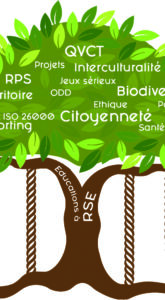
To respond to the societal demand that organizations and local communities address issues related to the ecological transition—including those related to health, the environment, and citizenship (climate change, biodiversity loss, discrimination/inclusion, secularism, pandemics, integrated health, etc.)—the private sector (companies; the social and solidarity economy; the nonprofit sector; corporate foundations), institutions, and local governments are increasingly committing—either voluntarily and/or under legal obligation—to sustainability policies.
The ReSoDDE program offers a generalist training course designed to foster an understanding of the transition process, with the goal of developing “green” skills (GreenComp, etc.) and “psychosocial” skills, which are closely interlinked.
It provides you with the capabilities you need to:
- design, manage and implement economic, social and environmental transition and innovation policies within learning organizations, anchored in a local reality.
In particular, it promotes:
- the development of collective, emotional and psychosocial intelligence, with a view to managing change management programs or psychosocial risks in the workplace.
- the acquisition of methods for systemic territorial analysis, including stakeholder dynamics, with a view to developing a “project-based territory” approach.
This program is open to students with general, scientific or professional bachelor's degrees (or equivalent). It takes two years to complete, and encourages professional internships in the first and second years.
The Master's degree enables students to develop skills that are conducive to these professional prospects:
- project manager, trainer, advisor or project manager in the field of Corporate Social Responsibility (CSR), including health/environment/citizenship issues, particularly in the associative and international solidarity sectors.
- auditor or consultant for the implementation of QHSE (ISO 9001, 14001...), sustainable real estate (AMU, HQE, BDO Occitanie, energy transition...) or CSR strategies in companies (extra-financial reporting, social innovation...).
- project or mission manager for policies on transition, biodiversity, youth, health... on contract in the public sector.
Finally, it offers the possibility of pursuing doctoral studies for research in these fields.
Training content
Focusing on case studies and fieldwork, the RESODDE-ESEC Master's degree offers training on the Sustainable Development Goals (SDGs) developed at different scales. It combines disciplinary knowledge, "green" skills and psychosocial competencies. It also develops an epistemological and psychological culture and an ethical approach through philosophical, sociohistorical and sustainability didactic approaches, and authentic tutored projects, thus linking theory and practice. Critical, systemic and complex thinking are reinforced by an introduction to research in the humanities and social sciences.
In the first year, significant practical experience is gained in the form of tutored projects on real orders under the guidance of professionals. This enables students to grasp the complexity of the professional world. The second year is open to work-study programs, and is organized so as to enable students to complete a long internship (up to 6 months), enabling them to enter the job market.
Organization
The course will take place on site at the Montpellier Faculty of Education.
In the first year of the Master's program, around half of the teaching units are shared with the other three courses in the Education and Training Sciences specialization.
The second year of the program is designed to enable students to gain professional experience (work-study or internship).
For professionals returning to school, this can be achieved over several years by capitalizing on the various UEs.
The dissertation can be based on an internship in France or abroad.
| Semester 1 | ECTS | Total student hours | |
| EU 101 | Development of training projects | 6 | 36 |
| EU 102 | Introduction to research | 4 | 30 |
| EU 104 | LV2 English | 2 | 15 |
| EU 105 | Epistemology and didactics of "education for" (Health, Environment, Citizenship) | 10 | 70 |
| EU 106 | Psychosocial approach to occupational health | 8 | 30 |
| Total semester 1 | 30 | 201 | |
| Semester 2 | |||
| EU 201 | Pedagogical engineering and training activities | 6 | 36 |
| EU 202 | Research methodology | 3 | 15 |
| EU 203 | Bibliographical studies | 2 | 15 |
| EU 204 | Sustainable development and corporate social responsibility: strategies and governance | 5 | 24 |
| EU 205 | Sustainable development and corporate social responsibility: social policy and local roots | 5 | 24 |
| EU 206 | Sustainable development and corporate social responsibility: environmental management | 5 | 24 |
| UE 20FI | Intercultural training | 4 | 20 |
| Total semester 2 | 30 | 138 | |
| Total hours M1 | 60 | 339 |
| Semester 3 | ECTS | Total student hours | |
| EU 301 | Ethical and political issues surrounding "education for". | 4 | 30 |
| EU 302 | Psychology of "education for | 3 | 21 |
| UE 303 | The subject in "education for | 3 | 21 |
| UE 304 | A curricular approach to "education for". | 6 | 40 |
| UE 305 | Introduction to research in the field of "education for". | 6 | 53 |
| UE 305.1 | Methodology and complex approach | 3 | 30 |
| UE 305.2 | Reading seminar | 3 | 23 |
| UE 306 | English reinforcement | 2 | 15 |
| UE 307 | Epistemology and didactics of "education for" (in-depth) | 6 | 40 |
| Total semester 3 | 30 | 220 | |
| Semester 4 | |||
| EU 401 | Territorial and organizational analysis methodology | 2 | 12 |
| EU 402 | Sensitive and topical themes in "Educations à | 8 | 48 |
| EU 403 | Serious games design | 3 | 16 |
| UE 404 | Professional project | 2 | 13 |
| UE 405 | Dissertation: support and defense | 15 | 5 |
| Total semester 4 | 30 | 94 | |
| Total hours M2 | 60 | 314 |