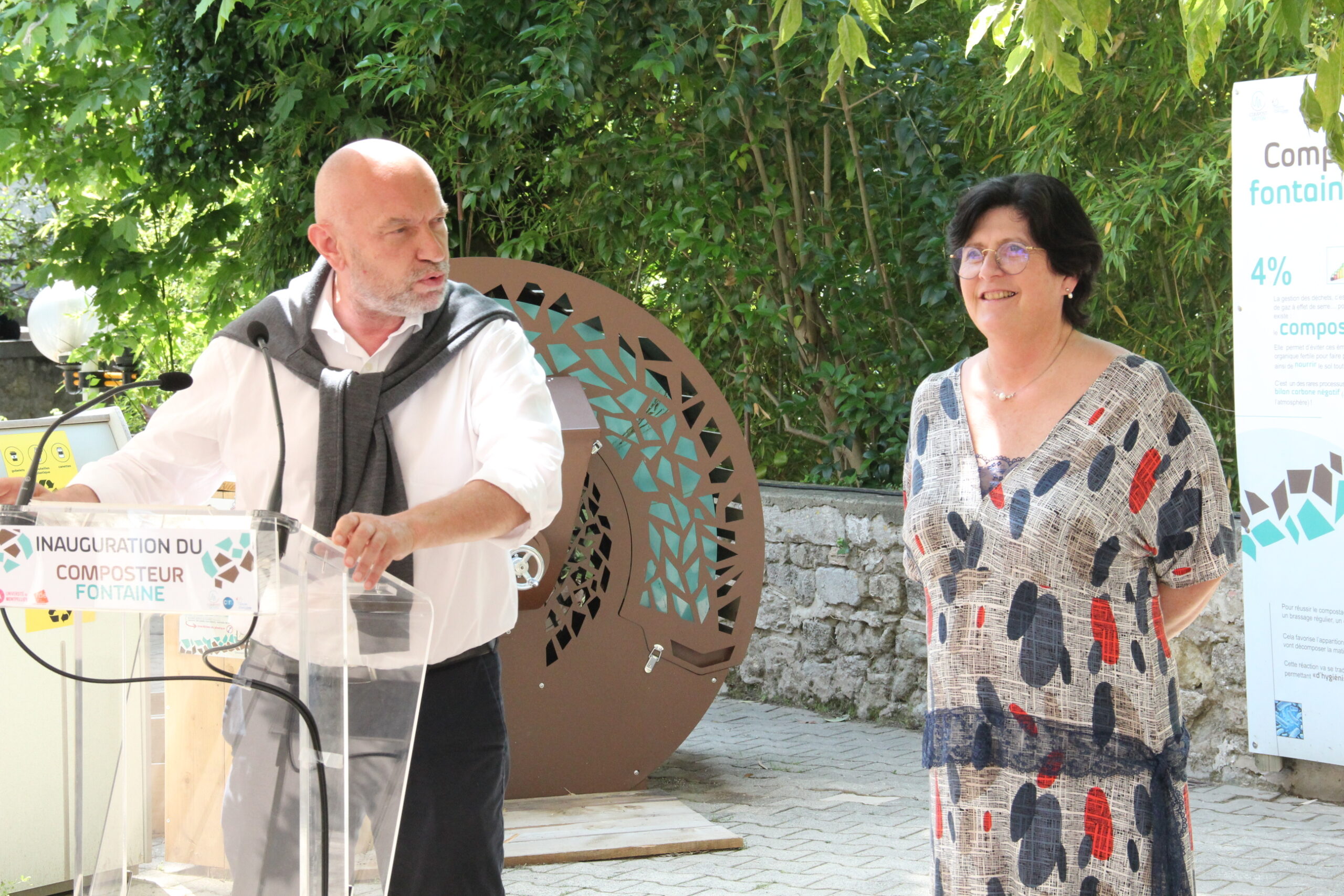
Inauguration of the Composter-Fountain at the Faculty ofÉducation on May 30
A smart composter at the Faculty of Education, Doesn't it make sense?
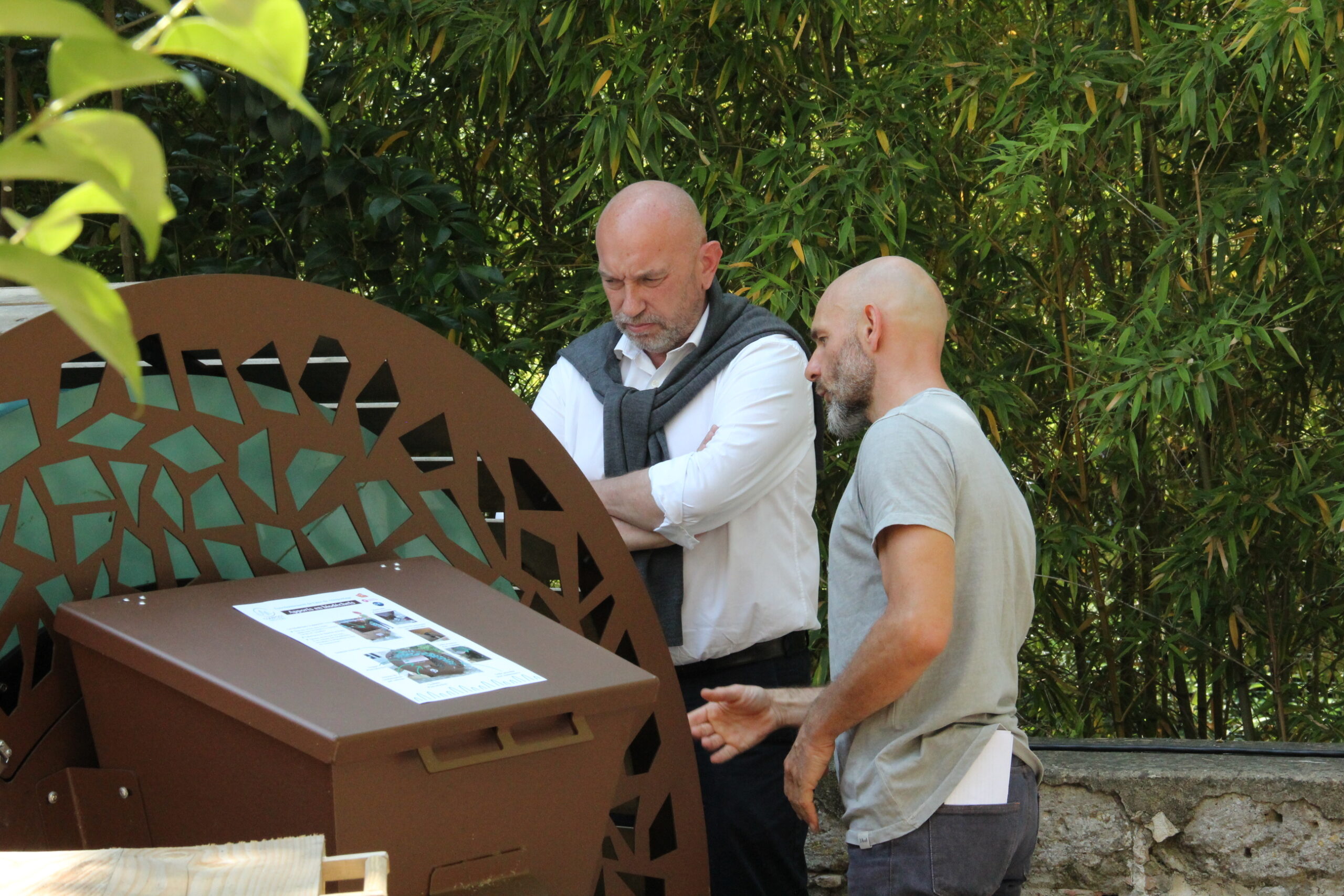
As part of its societal transition approach, the Faculty of Education at the University of Montpellier has joined forces with the project led by the CNRS Charles Coulomb laboratory and developed by Compost Motion to install a Fontaine composter in front of its cafeteria.
Patented technology
After several years' research, the patented design of this composter makes composting faster and safer, avoiding nuisance and automatically stirring the material. Its fountain-like design overturns the principle of a garbage room in favor of an attractive, lively, green space.
A civic-minded approach
The Fde's 2,500 staff and student users will be able to take action to improve their ecological footprint by recycling the bio-waste from their on-site meals, as well as bringing in their own bio-waste.
The objective is also educational, since it involves raising awareness among users and the participation of teams.
An In Situ research project
The Fontaine composter is instrumented to measure various parameters: temperature, humidity, gas concentration... to study the carbon balance of composting in order to reduce the greenhouse gases that contribute to global warming!
An innovative project, a virtuous circle...
- a) Waste issues :
Waste management accounts for almost 4% of our greenhouse gas emissions....but there's a simple, natural solution: composting. It avoids these emissions while producing fertile organic matter for plant growth. Compost nourishes the soil while sequestering carbon. It's one of the few processes that, according to ADEME, has a negative carbon balance (in other words, it removes CO2 from the atmosphere)!
- b) Compost :
All that's needed for successful composting is a little oxygen, regular stirring and a balanced input of material....this encourages the appearance of bacteria that will break down the material. This reaction results in a rise in temperature, making the compost "hygienic".
- c) The protagonists :
Compost-motion & its fountain composter
Arthur, an engineer by training, has made the reduction and recovery of organic waste a central concern. After several years of design and prototyping, the production of the first two full-scale models and a few months of experimentation, the fountain composter was born.
L2C & FDE
Environmentally aware researchers determined to reconcile their research with responses to environmental issues. That's how they came up with the idea of using the properties of graphene (a monolayer of carbon atoms) to detect low concentrations of gases....not just any gases, but the greenhouse gases that contribute to global warming! And to reduce them, of course!
- d) Genesis of the project: a meeting between the associative world and scientific research
After meeting in an associative setting...a few years ago...everyone went their separate ways, until the CNRS "climate change" call for projects (in 2020) offered an opportunity to reconcile science and the environment. The subject was obvious: using graphene's sensitivity to gaseous molecules to study the gases emitted during the composting process! The challenge will be to make graphene both selective and ultra-sensitive. Compost-motion offers the possibility of in-situ instrumentation.
- e) COMPOST: a CNRS-funded project, hosted and supported by the FDE of the University of Montpellier
The COMPOST project is one of the winners of the CNRS "climate change" call for projects, and has three objectives:
- environmental: a virtuous solution for bio-waste from the Fde cafeteria
- pedagogical: raising awareness and training Fde staff and students in this forward-looking practice
- scientific: the fountain composter is instrumented to measure various parameters: temperature, humidity, gas concentration (CO2, CH4, N20) to study the carbon footprint of composting and "optimize" it.