
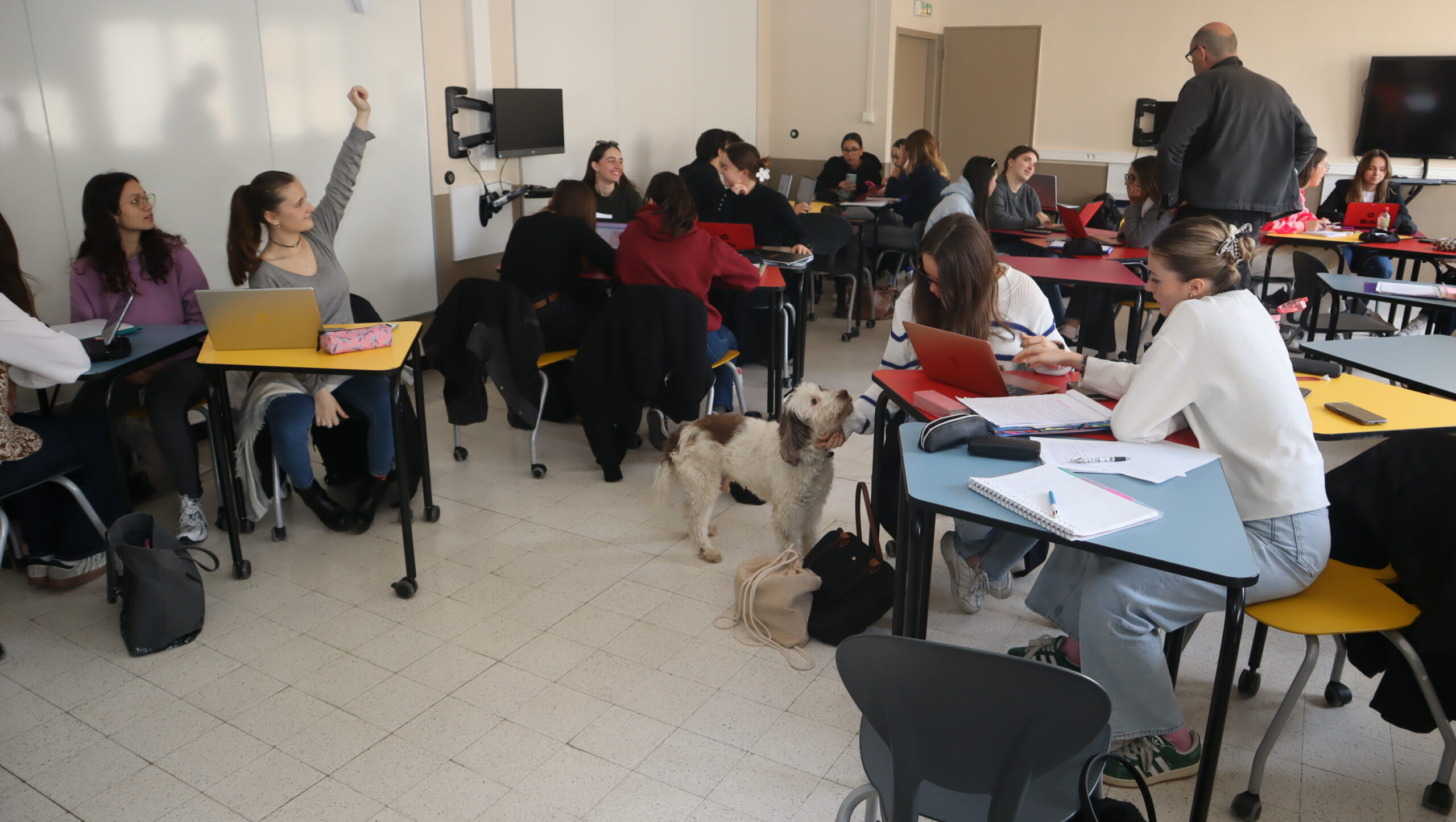
 Animal mediation experiments at the Montpellier Faculty of Education site
For the past few months, Ariol, a 13-year-old lagotto romagnolo, has been roaming the corridors of Montpellier's Faculty of Education to attend several degree courses. He's not a new student, but an indispensable participant in a novel experiment in the university environment, led by Sylvain Wagnon, a teacher-researcher in Education Sciences: the integration of animal mediation into the training of future teachers. Inspired by the successes observed in the medical and educational sectors, this initiative raises a number of questions and requires a few explanations.
Innovative educational leverage
Animal mediation is based on the idea that the presence of an animal can promote a calm school climate, reduce conflict and enhance learning. Studies have shown that interaction with pets enhances attention, reduces stress and facilitates communication between students, with a particularly beneficial impact on school inclusion.
However, setting up such a project required preparatory work to ensure that some students would not be reluctant to have an animal in class. Ariol, although trained and accustomed to working with children, was not destined to work in a school or university environment with a large number of students. His integration therefore raised specific issues that had to be anticipated. After the astonishment and initial contact, Ariol's presence became an expectation for the students. They greeted him, waited for him, looked for him and interacted with him during class.
A framework to be defined
This experiment is part of a research project conducted by the Montpellier Faculty of Education and the Inspé. Its aim is to encourage students to think beyond their own personal feelings. The aim is not to systematically generalize animal mediation in schools, but to encourage reflection on its own teaching and the appropriate educational framework. Numerous questions emerge: what type of animal is most suitable? What specific skills do teachers need to acquire? One of the major challenges of this experiment is to establish a precise framework, based on research in ethology and education.
A balanced relationship between students and animals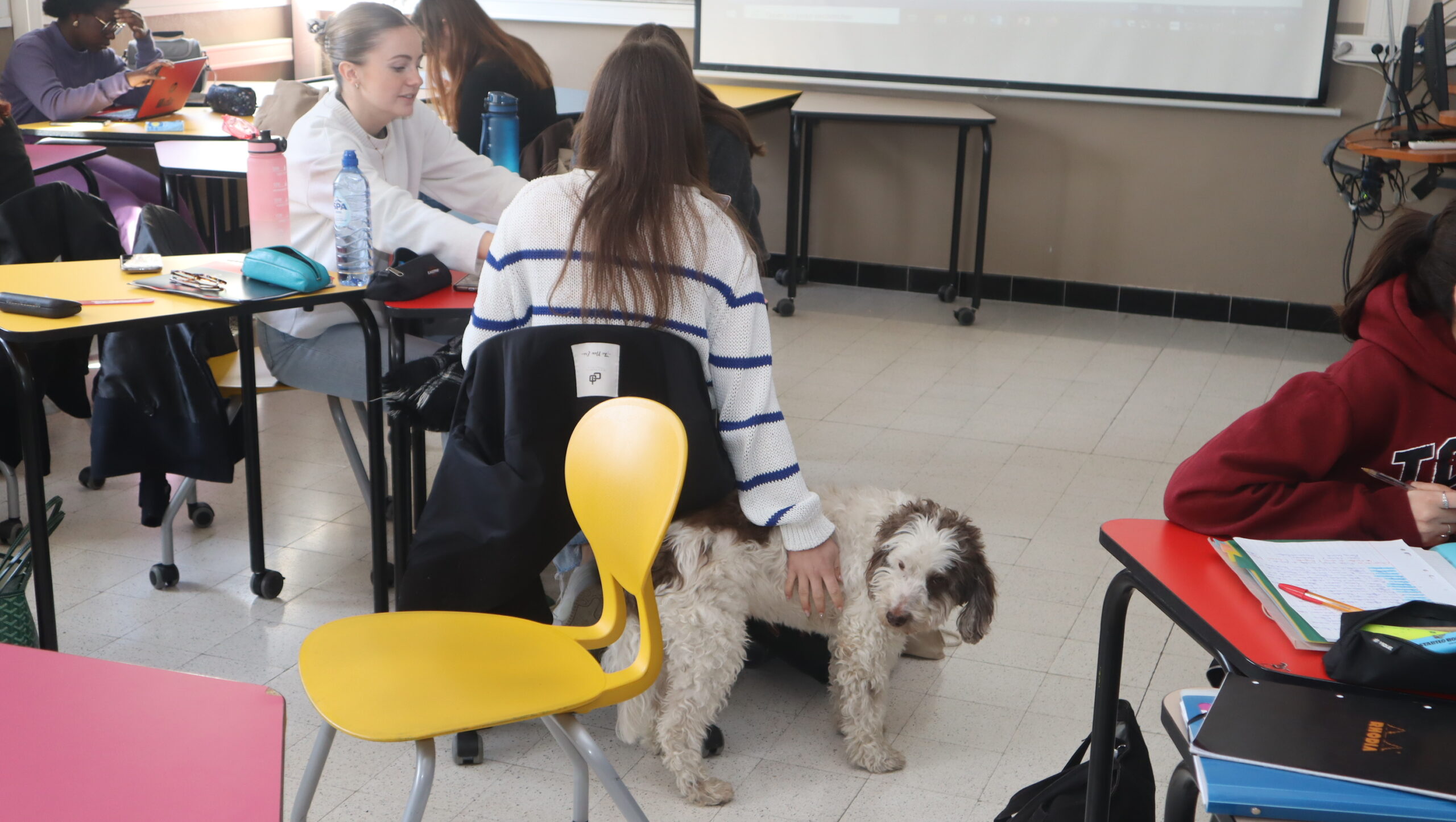
One of the most innovative aspects of the project is its focus on animal welfare. Unlike some research that focuses solely on the benefits for the students, this experiment also emphasizes the feelings and needs of the animals involved. The students quickly perceived Ariol's signs of fatigue and his search for a place to rest, just as they observed his active role as mediator. In just a few months, the first results are visible, notably in terms of the teaching relationship and the climate in the classroom.
Towards a continuation of the experiment?
While the initial results merit further analysis from the point of view of the students, the animal, myself as a teacher-researcher and the faculty staff, this project is part of a wider movement. The Montpellier academy is a pioneer in this field, with experiments already underway in secondary education, notably with CPEs. This experimentation in the faculty of education needs to be taken further; it represents a first step towards a wider reflection on the place of animals in education. By combining a scientific approach with feedback from experience, we hope it will help redefine some of tomorrow's teaching practices.
Sylvain Wagnon, teacher-researcher in Education Sciences
To find out more : The Conversation article