(PLURI and MEEF)
Contact / Information
Education Department - Faculty of Education
Tel : 04 67 61 82 83
Course leaders
Registration
Montpellier Faculty of Education on parcoursup
Training locations
Carcassonne, Mende, Montpellier, Nîmes, Perpignan

The Faculty of Education at the University of Montpellier offers a multi-disciplinary bachelor's degree at its Carcassonne, Mende, Montpellier, Nîmes and Perpignan sites, in addition to its MEEF master's programs preparing students for the teaching profession.
General objectives :
- From the 1st year of the bachelor's degree, train students who wish to prepare for the competitive examination to become a school teacher, by taking the first-degree MEEF masters courses.
- Acquire the knowledge and develop the multi-disciplinary and professional skills needed to succeed in the competitive examination and practice the profession.
- Consolidate your career plans to become a primary school teacher, or reorient your career plans towards the various professions in leadership, mediation, teaching, education and training.
Training content
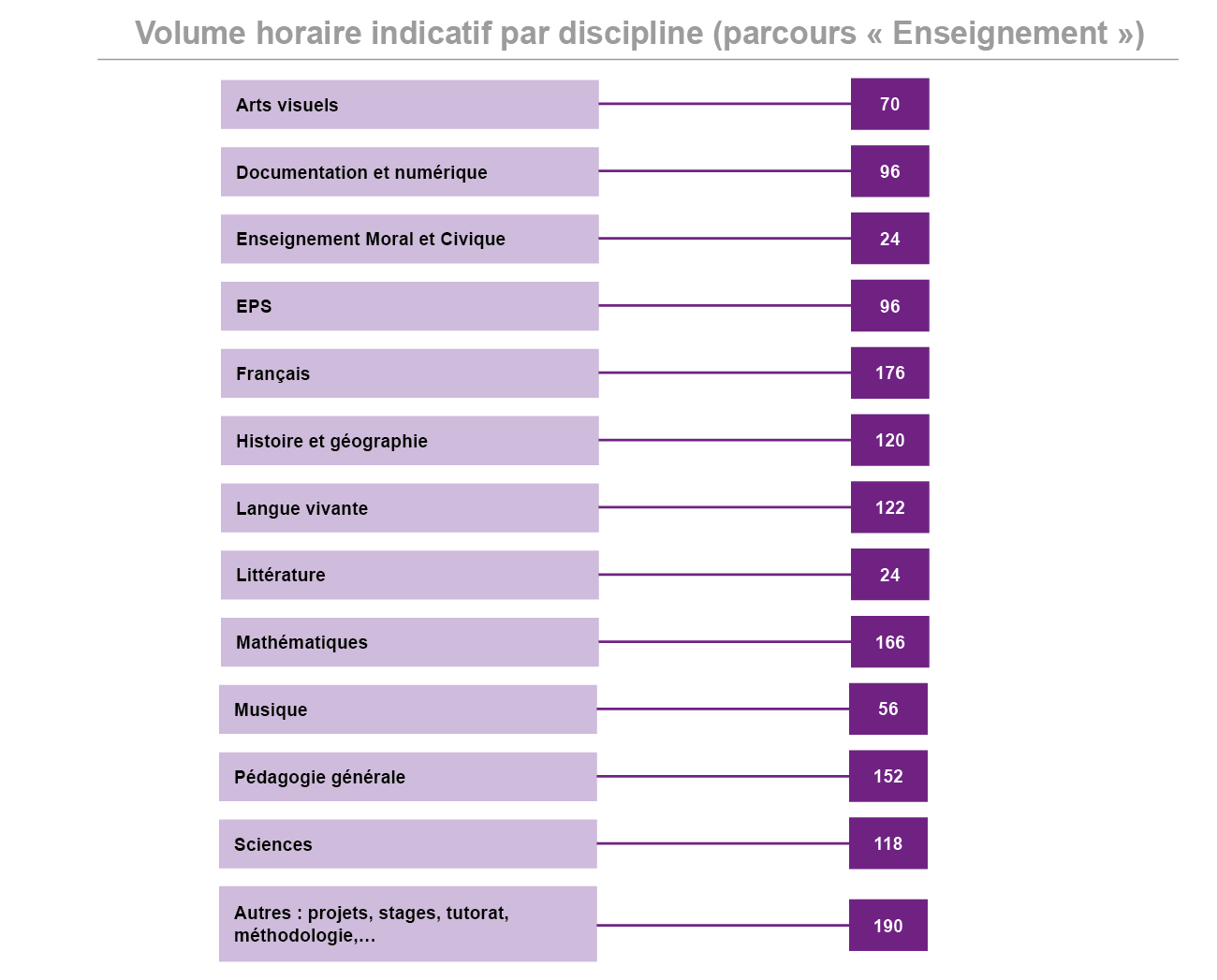
They cover all the subjects taught in elementary school, as well as sociology of education, philosophy of education and child psychology, among others. All contents are worked on to develop the following skills:
- Competency 1: Develop and exercise critical thinking skills
- Competency 2: Communicates appropriately
- Skill 3: Information processing
- Competency 4: Develops and exercises creativity
- Skill 5: Problem solving
- Competency 6: Develop a non-violent relationship with oneself, others and the group
- Competency 7: Cooperates and works as part of a team
- Competency 8: Develops effective work methods
- 6 semesters over 3 years (L1, L2, L3);
- 250 h on average per semester (1500 hours) ;
- 50 teaching units.
- This bachelor's degree is structured around 8 cognitive, methodological and relational skills, enabling the various disciplines to converge towards the expectations of the professions of animation, mediation, teaching, education and training.
In L1, she questions the School's disciplinary knowledge.
In L2, a study period of several months is offered abroad (or internships abroad and in France).
In L3, a teaching course and two sub-courses, "Education and Training" and "Animation, Mediation and Training", enable students to choose from a range of Masters courses and professional outlets.
While the MEEF 1er degré master's degree is the natural continuation of this bachelor's degree, other career paths are also possible:
- Master's degree in Education and Training Sciences from the Faculty of Education: comprising three courses with specific professional and scientific aims (EIFALLE, MAC, ReSoDDE-ESEC), this master's degree is aimed at people interested in educational issues in the broadest sense of the term (school training, informal education, adult training, etc.).
- Master's degree in educational management for future principal educational advisors (CPEs) in middle and high schools.
- Professional training in social work (specialized educator, early childhood educator, social assistant, etc.).
Teaching in L1
| Semester 1 | Semester 2 | H | |
|---|---|---|---|
| Developing and exercising critical thinking skills | |||
| Knowing / understanding disciplines - French - literature |
24 | Knowing / understanding disciplines - Arts |
24 |
| - Sciences | 24 | - History-geography | 24 |
| - Mathematics | 24 | - EPS | 24 |
| - History of education and teaching | 24 | ||
| Communicate appropriately | |||
| Produce images by crossing disciplines (arts, sciences) | 24 | Public speaking: - Crossing disciplines (French, PE, body and voice, music) |
24 |
| - In a foreign language | 24 | ||
| Exploiting information | |||
| Searching for information - Cross-disciplinary (French, PE, music) |
24 | Prioritize information across disciplines (French, art, history-geography) | 24 |
| - In a foreign language | 24 | School internship | 12 |
| Developing and exercising creativity: workshops | |||
| - Writing | 12 | - Artistic practices | 12 |
| - Artistic practices | 24 | - Cultural practices | 4 |
| - Cultural practices | 4 | ||
| Solving problems | |||
| Structuring fundamental knowledge (mathematics) | 12 | Structuring basic skills (French) | 12 |
| Dealing with complex situations: | |||
| - Digital environment | 12 | ||
| - In mathematics and science | 36 | ||
| Developing effective working methods | |||
| Tools and methods for success at university (protection / security / methodology / documentation / tutoring) | 48 | Tools and methods to succeed at university (methodology / tutoring) | 12 |
| Yes if" answers: teacher tutoring and refresher courses in French or math : 30h in semester 1 and 30h in semester 2 |
|||
Three optional courses are offered throughout the degree: a "choir" course, a "webradio" course
and a "regional languages" UE. The latter is offered only in Carcassonne (Occitan) and Perpignan (Catalan).
| Semester 3 | Semester 4 | |
|---|---|---|
| Developing and exercising critical thinking skills | H | In Year 2, Semester 4, offers students a choice between two options students the choice between two options: 1/ Those wishing to do so can spend a semester abroad, at one of our partner universities offering courses related to the teaching, education teaching, education and training (subject to availability). 2 / Those who do not wish to a full semester abroad abroad are offered shorter shorter internships in foreign schools schools abroad and in educational, cultural or educational, cultural or social in France. |
| Knowing / understanding disciplines
- Moral and civic education |
24 | |
| - Living language | 24 | |
| - Sociology of education | 24 | |
| International comparisons | 18 | |
| Communicate appropriately | ||
| Producing written works - Crossing disciplines (French - mathematics - history-geography) |
24 | |
| - PIX: content creation | 12 | |
| - In modern languages | 12 | |
| Exploiting information | ||
| Selecting information - Crossing disciplines (French - mathematics - science - documentation) |
24 | |
| - PIX: information and data | 12 | |
| - In modern languages | 12 | |
| Developing and exercising creativity: workshops | ||
| - Scientific practices | 12 | |
| - Sports activities | 12 | |
| - Cultural practices | 4 | |
| Solving problems | ||
| Structuring fundamental knowledge (French) |
12 | |
| (mathematics) | 18 | |
| Develop a non-violent relationship with yourself and others | ||
| Self-esteem and self-regulation | 24 | |
| Cooperation and teamwork | ||
| Collaborative projects | 16 | |
| Developing effective working methods | ||
| Tools and methods to succeed at university (methodology / tutoring) |
12 | |
| Semester 5 | Semester 6 | ||
|---|---|---|---|
| Teaching" pathway | |||
| Developing and exercising critical thinking skills | H | ||
| Knowing / understanding the disciplines - Child psychology |
24 | Knowing / understanding disciplines - Philosophy of education |
12 |
| From disciplines to didactics - Visual arts, music, modern languages, French, mathematics |
90 | From disciplines to didactics - History-geography, PE, science, French, mathematics |
102 |
| International comparisons | 12 | End-of-licence assessment | 5 |
| Communicate appropriately | |||
| Produce images by crossing disciplines (History-geography, documentation) |
24 | ||
| Exploiting information | |||
| School internship | 12 | Prioritize information (cross-disciplines: French, art, history-geography) |
24 |
| Developing and exercising creativity: workshops | |||
| - Scientific practices | 12 | - Writing | 12 |
| - Sports activities | 8 | - Cultural practices | 8 |
| - Cultural practices | 4 | - Cultural practices | 4 |
| Solving problems | |||
| Structuring fundamental knowledge - French |
12 | Create complex situations (cross-disciplines: EPS, history-geography) |
24 |
| Structuring fundamental knowledge - Mathematics |
24 | Complex situations for school (cross-disciplines: French, math, LV) |
24 |
| Develop a non-violent relationship with yourself and others | |||
| Conflict resolution | 24 | Educational relationships: authority and authorization | 24 |
| Cooperation and teamwork | |||
| Project pedagogy 1 - PIX: communication and collaboration |
12 | Project pedagogy 2 | 24 |
| - Cross-cutting themes | 16 | ||
| End-of-bachelor's degree assessment | 4 | ||
| Developing effective working methods | |||
| In-school internship support | 24 | ||
| Student tools and methods | 12 | ||
| Semester 5 | Semester 6 | ||
|---|---|---|---|
| Courses common to the "Teaching" pathway and the "Education and training" sub-courses / "Animation, mediation and training" sub-courses |
|||
| Developing and exercising critical thinking skills | H | ||
| Knowing / understanding the disciplines - Child psychology |
24 | Knowing / understanding disciplines - Philosophy of education |
12 |
| International comparisons | 12 | End-of-licence assessment | 5 |
| Solving problems | |||
| Structuring fundamental knowledge - French |
12 | Structuring fundamental knowledge - Mathematics |
24 |
| - French | 12 | ||
| Develop a non-violent relationship with yourself and others | |||
| Conflict resolution | 24 | 24 | |
| Cooperation and teamwork | |||
| Project pedagogy 1 - PIX: communication and collaboration |
12 | Project pedagogy 2 | 24 |
| - Cross-cutting themes | 16 | ||
| - End-of-bachelor's degree assessment | 4 | ||
| Lessons specific to the "Education and training" sub-course | |||
| - Pre-professional project 1 - Sociology of youth and cultural practices 1 - Priority audiences and territories - Psychology of adolescence |
- Pre-professional project 2 - Sociology of youth and cultural practices 2 - Inequalities and discrimination - School life, mediation, justice - Social uses of digital technology and networks |
||
| Courses specific to the "Animation, mediation and training" sub-course | |||
| - Pre-professional project 1 - Communication and education 1 - Introduction to training engineering - Culture and interculturality |
- Pre-professional project 2 - Communication and education 2 - Introduction to the didactics of "education for - Introduction to language didactics - Introduction to mediation |
||